
Genetic Basis of Anthocyanin Variation in Purple Bud Tea Plants Uncovered
Recently, the Tea Germplasm Resource Innovation Team of TRI CAAS has published a new study in The Plant Journal revealing the genetic mechanism behind anthocyanin accumulation in tea plants. The papre, titled “Cis-regulatory evolution of CsANS1 drives cultivar variation in anthocyanin accumulation in tea plants,” identifies anthocyanin synthase (CsANS1) as a key genetic determinant of this trait.
Using an F1 hybrid population derived from the high-anthocyanin cultivar ‘Zijuan’ (ZJ) and the low-anthocyanin cultivar ‘Jinxuan’ (JX), the team conducted a systematic investigation integrating metabolomics, transcriptomics, population genetics, and molecular biology. Joint analysis of the metabolome and transcriptome of the F1 hybrid population revealed a highly significant positive correlation between CsANS1 expression and anthocyanin content, establishing CsANS1 as the core gene driving anthocyanin variation in this hybrid population.
While two non-synonymous mutations exist within the CsANS1 coding region, heterologous overexpression experiments in Arabidopsis demonstrated no significant functional differences between the alleles. The key lies in the CsANS1 promoter region: a conserved 192-bp insertion fragment is present in the promoters of CsANS1 from high-anthocyanin varieties, while this fragment is completely absent in low-anthocyanin varieties. This insertion fragment was tightly linked to the high-anthocyanin phenotype in the hybrid population. Promoter activity was significantly enhanced by this 192 bp insertion, and its presence markedly boosts the transcriptional activation of CsANS1 by the transcription factor CsMYB75.
Furthermore, the study elucidates a post-transcriptional regulatory network governing anthocyanin accumulation. A regulatory module comprising CsmiR156b, CsSPL9, and CsMYB75 mediates the spatiotemporal fine-tuning of CsANS1 expression. CsmiR156b targets and degrades CsSPL9 transcripts, thereby weakening the protein interaction between CsSPL9 and CsMYB75. This, in turn, enhances the activation activity of the MBW complex formed with CsMYB75 as a key component on the CsANS1 promoter. This discovery provides new insights into understanding the molecular mechanism of high anthocyanin content in tea plants and for breeding improved cultivars.
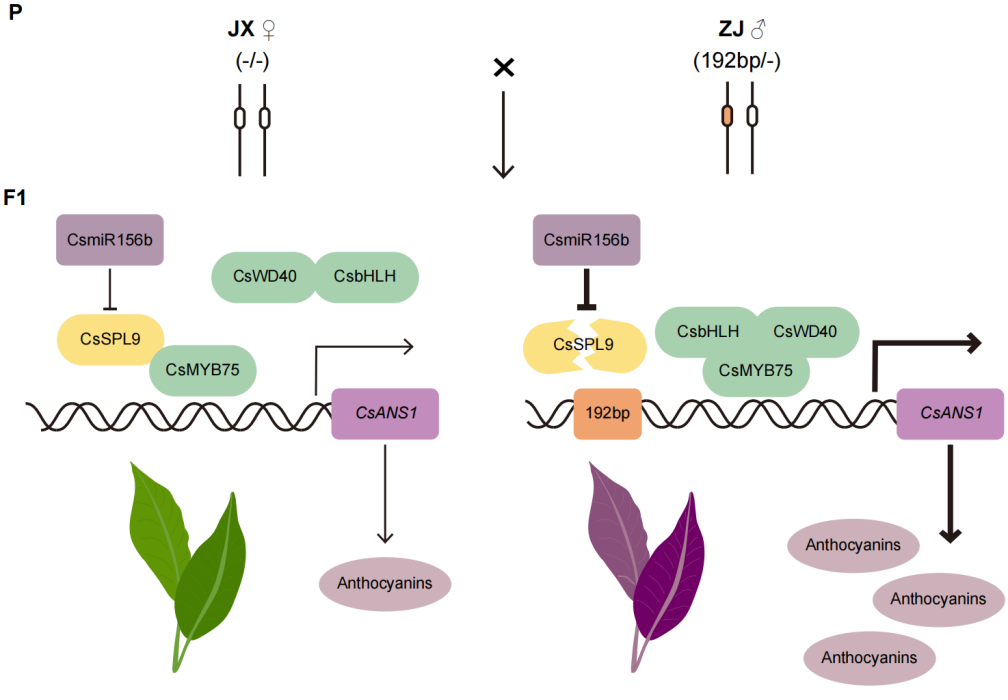
First authors are master's students Yiming Liu and Xiaoying Xu (TRI CAAS). Corresponding authors are Professor Liang Chen, Jiqiang Jin and Assistant Professor Xuecheng Zhao. This study was supported by the Key Scientific and Technological Grant of Zhejiang for Breeding New Agricultural Varieties, the Agricultural Science and Technology Innovation Program (ASTIP), Key Research Tasks of the Tea Research Institute, Chinese Academy of Agricultural Sciences, and the Jiangxi Provincial Talent Program.
Link: 10.1111/tpj.70741
By Xuecheng Zhao (zhaoxuecheng@tricaas.com)